




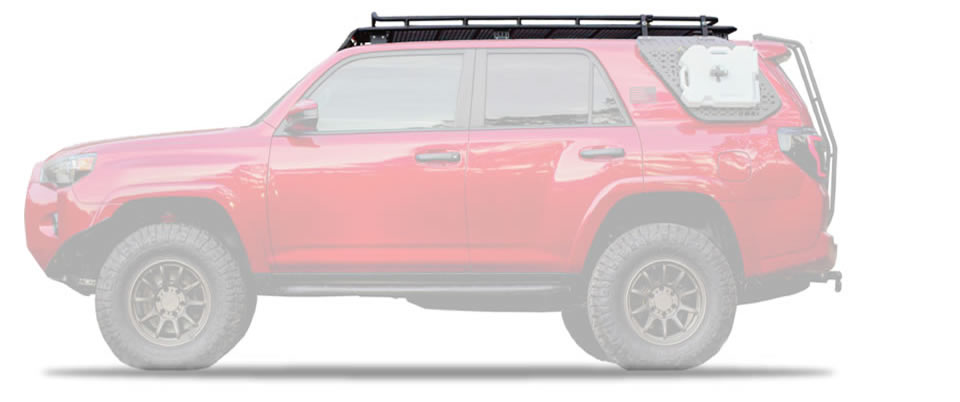
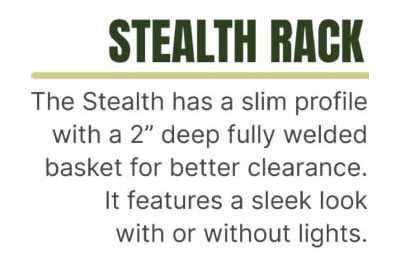
ADDITIONAL ROOF RACK ACCESSORIES
Your GOBI roof rack is engineered to securely support all your gear, so you can head into your next adventure with complete confidence.
ta 4Runner 6th Generation Roof Racks (2025–Present)
Engineered for the Most Advanced 4Runner Ever Built
Toyota didn’t reinvent the 4Runner for its sixth generation just to make it lighter, trendier, or louder. The 2025–present 6th Gen 4Runner represents a refinement of everything that made the platform legendary: durability, longevity, and real-world capability, now paired with modern engineering, tighter tolerances, and advanced safety systems.
A roof rack designed for this vehicle must respect that evolution.
GOBI Roof Racks for the 6th Gen Toyota 4Runner are engineered with a single principle in mind: build something worthy of the platform, not merely compatible with it.
Ask? What Changed on the 6th Gen 4Runner &
Why It Matters
The sixth-generation 4Runner introduces meaningful changes that directly affect roof rack design:
-
Updated roof geometry and mounting architecture
-
Revised body contours and airflow characteristics
-
Increased integration of sensors, cameras, and safety systems
-
Higher expectations for refinement, noise control, and longevity
These changes expose a quiet truth in the roof rack market:
Many racks were adapted. Very few were truly engineered.
On a brand-new vehicle, especially one designed for long-term ownership, permanent drilling, excessive assembly points, or poorly managed wind dynamics are no longer acceptable compromises.
The Hidden Problem with Most 6th Gen 4Runner Roof Racks
At first glance, many modern roof racks appear similar. Low profile. Flat platforms. Black powder coat. Modular components.
Look closer, however, and patterns emerge.
Most racks on the market today rely on:
-
Multi-piece aluminum assemblies
-
Numerous fasteners and joints
-
Torque-dependent structural integrity
-
Modular systems are designed for adaptability, not permanence
There is nothing inherently wrong with modularity. It serves a purpose.
But modular systems introduce variables, which reveal themselves over time.
More joints mean:
-
More opportunities for movement
-
Greater reliance on periodic re-torque
-
Increased potential for wind noise as tolerances shift
-
A higher likelihood of audible vibration as miles accumulate
Some owners value adjustability above all else.
Others value something quieter, more settled, and more enduring.
GOBI’s Engineering Philosophy for the 6th Gen 4Runner
GOBI takes a fundamentally different approach.
Rather than designing a rack that can be assembled, GOBI builds a rack that is complete from the start.
Fully Welded Construction
Each GOBI roof rack for the 6th Gen 4Runner is fully welded, not bolted, forming a single, unified structure that remains rigid for the life of the vehicle.
There are fewer variables because there are fewer parts.
No-Drill, Vehicle-Specific Mounting
The rack is engineered to mount securely without drilling or irreversible modifications. This preserves:
-
Factory sealing
-
Structural integrity
-
Long-term resale value
Especially important on a brand-new platform.
Wind Management Is Not Optional
Every GOBI rack includes a purpose-built wind deflector as part of the system, not an upsell. Wind behavior is addressed at the engineering level, not left to chance.
The GOBI rack is designed to support real loads rather than just marketing numbers.
The rack is built to carry:
-
Rooftop tents
-
Recovery gear
-
Overland equipment
-
Expedition cargo
It’s not just about looking capable in photos.
A Clear Comparison: Two Philosophies
Common Industry Approaches
-
Modular aluminum platforms
-
Multi-piece assemblies
-
Torque-dependent systems
-
Greater flexibility, greater variability
The GOBI Approach
-
Fully welded steel construction
-
Fewer components, fewer failure points
-
No drilling required
-
Designed for long-term ownership
Popular alternatives include Prinsu, Westcott Designs, Sherpa Equipment, Rhino-Rack, and Front Runner. Each serves a different buyer profile.
This page exists for owners who prioritize stability, refinement, and permanence over constant adjustment.
Installation Confidence
What 6th Gen Owners Care About
A roof rack should inspire confidence before the first mile.
GOBI racks are designed to:
-
Install without drilling into your new 4Runner
-
Maintain proper weather sealing
-
Minimize wind noise through integrated airflow management
-
Remain quiet over time, not just on day one
-
Support Thule and Yakima compatible accessories
-
Handle real-world overland use, not just weekend errands
The result is a system that feels engineered rather than improvised.
Low Profile When You Want It. Capable When You Need It.
The 6th Gen 4Runner blends urban usability with genuine off-road capability. A roof rack should do the same.
GOBI’s low-profile design preserves:
-
Clean vehicle lines
-
Garage and parking structure clearance
-
A refined appearance appropriate for daily driving
While still delivering the strength required for expedition use.
Why 6th Gen 4Runner Owners Choose GOBI
Not everyone needs a rack built this way.
But for those who plan to keep their 4Runner for years, not seasons — the decision becomes clear.
GOBI appeals to drivers who:
-
Intend to use their rack, not just admire it
-
Prefer fewer parts to constant adjustment
-
Value craftsmanship over trends
-
Want a rack that feels permanent, settled, and intentional
This is not a rack designed to be replaced.
It is built with the same expectation of longevity that defines the 4Runner.
Explore Other 4Runner Generations
If you’re researching across generations, continue here:
-
5th Gen Toyota 4Runner Roof Racks (2010–2024)
-
4th Gen Toyota 4Runner Roof Racks (2003–2009)
-
3rd Gen Toyota 4Runner Roof Racks (1996–2002)
Each generation tells a different story.
Each requires a different engineering response.
GOBI vs. Other Roof Racks
| Feature | GOBI Toyota Roof Rack | Rhino-Rack / Yakima / Westcott |
|---|---|---|
| Construction | Fully welded, no moving parts | Modular; bolts loosen over time |
| Installation | 100% No-Drill | Often requires drilling or modifications |
| Noise Control | Whisper-quiet, wind deflector included | Can rattle, whistle, or hum |
| Included Accessories | Rear hatch ladder, crossbars, wind deflector | Sold separately |
| Durability | Powder-coated, built to last decades | Powder coating varies and may be prone to wear |
| SUV Prestige Fit | Designed to complement Toyota styling | Often boxy, off-road–only look |